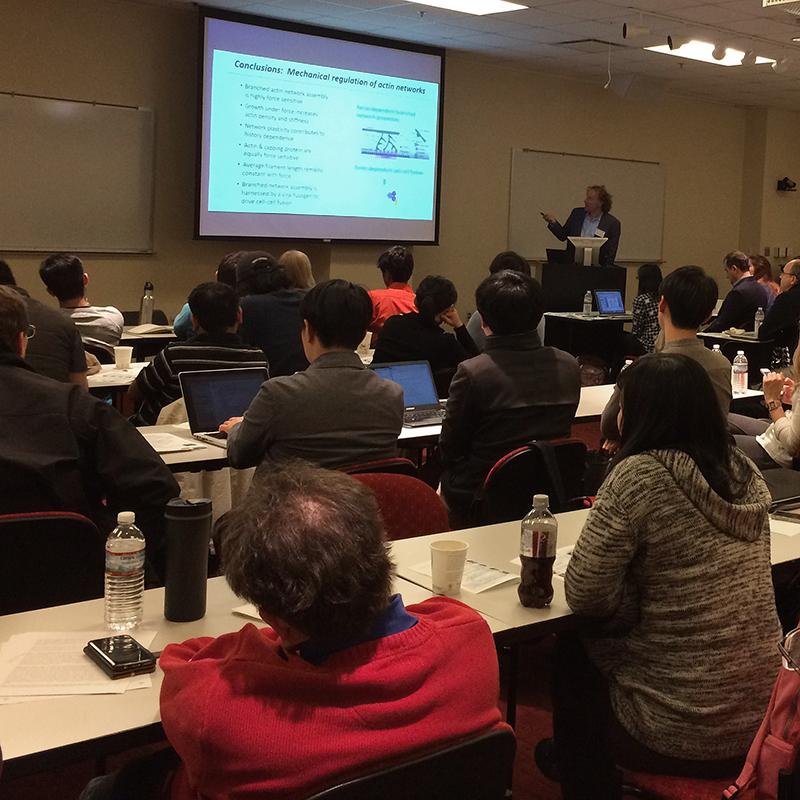
Director's WelcomeThe mission of the Institute for Physical Science and Technology (IPST) is to foster excellence in interdisciplinary research and education at the University of Maryland. IPST accomplishes this by integrating people, science and technology. Our selective and highly ranked graduate programs in the fields of provide specialized training at the intersection of traditional fields, and are a central component of our mission. IPST Spring Assembly Meeting The Physical Sciences Complex (PSC) will
host state of the art office and laboratory space, making it the nation's
finest university research facility in the physical sciences. The PSC
will house the departments of Astronomy, Physics, and the Institute
for Physical Sciences and Technology. We invite you to track the construction progress
of this remarkable building.
|
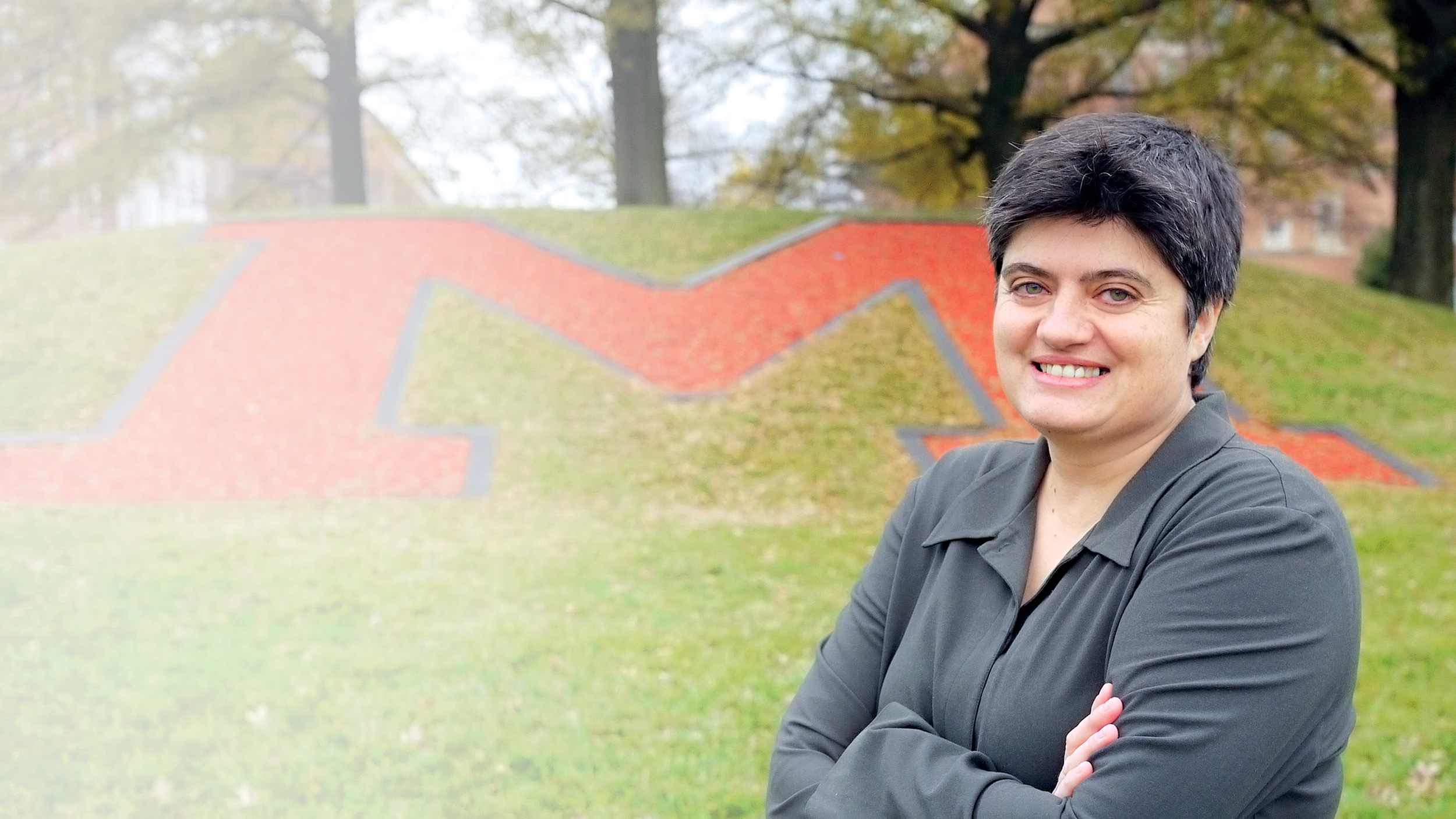
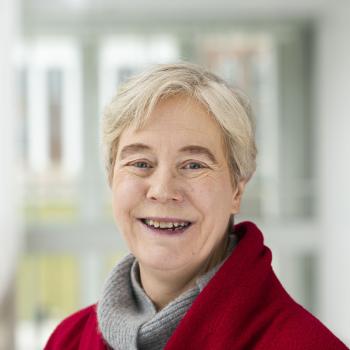
News and Special EventsEugenia Kalnay featured in IANAS bookApril 22, 2013. The Interamerican Network of Academies of Sciences (IANAS) has published a book - Women Scientists of the Americas. Their inspiring stories - in which the life of Eugenia Kalnay, a Distinguished University Professor and IPST faculty member, is profiled among those of other remarkable women who have worked, somtimes against great odds, to make a career in a world that has not alway been welcoming to them. The book demonstrates that even under difficult political conditions and without abundant resources, determined women scientists developed strategies to establish eminent careers throughout the Americas. The book is free for download from the IANAS book download page. Nature Chemistry publication by Millard H. AlexanderApril 22, 2013. Distinguished University Professor and IPST faculty member Millard H. Alexander's work OH electron, where art thou? was publish in the April 2013 (vol. 5, pp. 253-255) issue of Nature Chemistry. This is a perspective article, written at the level of a good chemistry undergraduate, in which Dr. Alexander describes new experiments that shed light on the intricacies of the reaction between oxygen and hydrogen, phenomenon that still defies full explanation. Dark Matter Possibly Found by $2 Billion Space Station ExperimentApril 20, 2013. The Alpha Magnetic Spectrometer (AMS) instrument on board of the International Space Station has recorded a signal, after billions of particle events, that may be the result of dark matter. Professors Eun Suk-Seo and Roald Z. Sagdeev, both IPST members, participated in this international effort. For more information, read CERN's press release. Former IPST director K. Sreenivasan appointed president of NYU-PolyApril 11, 2013. Former director of IPST and Distinguished University Professor Katepalli Sreenivasan, affectionately known as Sreeni, has been appointed President of the Polytechnic Institute of New York University (NYU-Poly.) Read NYU-Poly's press release for more information. New discovery sheds light on possible photochemical activity on Titan's low-altitude atmosphereApril 4, 2013. Murthy Gudipati, and his team at NASA's Jet Propulsion Laboratory, have discovered, in controlled experimental conditions that simulate the atmosphere of Titan, Saturn's moon, the presence of photochemical activity at lower altitudes than previously thought possible. This activity can produce complex organic compounds that could eventually lead to the building blocks of life. The results were published in Nature Communications this week. Read the full NASA press release for more information on this fascinating discovery. Mikhail Anisimov elected member of Russian academiesApril 2, 2013. Professor Mikhail Anisimov has been elected a foreign member of the Russian Academy of Engineering (RAE) and the Russian Academy of Natural Sciences (RANS). The RANS is a public organization that was founded on August 31, 1990 in Moscow, while the RAE is a public academy of sciences, which unites leading Russian and foreign scientists, engineers, scientific-research organizations, higher educational institutions and enterprises. It is the legal successor of the Engineering Academy of the USSR. |


SeminarsFrank W. J. Olver 1924-2013
Born in 1924 in Croydon, UK, Frank showed deep interest in mathematics and proved himself a mathematical talent at a young age. He obtained a first class honors in mathematics for his bachelor’s degree from the University of London in 1944. He received a master’s degree in 1948 and completed the D.Sc. in mathematical analysis in 1961. After completing his undergraduate studies at age 19, Frank was assigned to the British Admiralty Computing Service where he was first introduced to numerical analysis. It was at that time his research direction in special functions began to take shape. Soon after the war, he joined the Mathematics Division of the National Physical Laboratory (NPL), Teddington, UK, as Scientific Officer, and became one of the founding members of the Mathematics Division of the Laboratory from 1945-1961. There, he met his first wife, Grace E. Olver (nee Smith). They were married in 1948, and had three children, Peter (1952- ), Linda (1953-1965), and Sally (1955- ). During 1957-58, Frank visited the National Bureau of Standards in Washington DC, which subsequently became the National Institute of Standards and Technology (NIST), to help work on the well-known and highly cited Handbook of Mathematical Functions by Abramowitz and Stegun. In 1961, he moved permanently to NIST, now in Gaithersburg, MD. He retired in 1986, but continued to be active in mathematics at NIST until his death. In 1969, he became a Research Professor at the University of Maryland where he worked and taught for 23 years until he retired in 1992 at the age of 68 and was appointed Professor Emeritus. Frank’s first book, Asymptotics and Special Functions, published in 1974 by Academic Press, became a standard reference in the fields of asymptotics and special functions. In 2000, a two-volume commemorative collection of selected papers of Frank was published. The 1074-page collection consisted of 56 papers covering his most important contributions in the areas of asymptotic analysis, special functions, and numerical analysis, from 1949 to 1999. One review of the collection, said "the papers exemplify a redoubtable mathematical talent, the work of a man who has done more than almost anyone else in the 20th century to bestow on the discipline of applied mathematics the elegance and rigor that its earliest practitioners such as Gauss and Laplace would have wished for it." Frank was very active in the Society for Industrial and Applied Mathematics (SIAM). He helped found the SIAM Journal on Mathematical Analysis and served as its first managing editor, from 1970-1975. He was also a long time member of the American Mathematical Society (AMS) and the Mathematical Association of America (MAA).
Frank is survived by his wife of 23 years, Claire, brother Terence, two children, Peter and Sally, their spouses Cheri and Neal, and five grandchildren, Parizad, Krista, Sheehan, Brian, and Noreen. Peter Olver There are no seminars today. For future seminars, please follow the link below. |